


Best Toddler Tower Activities (by 18-36 months)
Share
Why should your child be at the counter at all?
Having your toddler positioned at counter height isn’t just about convenience, it’s about connection, inclusion, and growth. When children between about 18-36 months stand on a real, safe platform like our Toddler Tower, they’re not merely “helping” from afar, they’re physically part of the scene. They’re no longer spectators but participants. That shift makes a big difference.
At this age kids are curious, capable of more than we often give them credit for, and eager to imitate and engage. By placing them at the counter you are saying: “You matter. You belong. You’re invited.” That invitation fosters independence, confidence, and a sense of being valued. And when you use a purpose-built piece of furniture that supports safe access to the kitchen or sink, you’re enabling all of those things to happen in a practical way, making your home accessible to your child.
Benefits of counter-level involvement: cooking, cutting, washing, etc.
1. Hands-on learning of everyday life skills
When your toddler stands at the counter with you and washes vegetables, rinses lettuce, helps stir a bowl, or even uses a safe toddler‐knife under supervision, they are learning. They are watching your movements, practicing theirs, and internalizing routines. These are foundational life skills, skills that help them feel capable, useful, and part of the household rhythm.
2. Physical coordination and sensory input
Standing on something safe and stable like the Toddler Tower helps with gross motor strength, balance, and body awareness. Reaching for a bowl, turning a spoon, tasting, smelling, all of that sensory input is rich and meaningful for toddlers. They’re not just sitting watching, they’re doing.
3. Language and cognitive growth
As you talk through what you’re doing (“I’m washing the carrots. Now you can stir.”) you’re offering language, sequencing, cause and effect. It’s not just “wash carrots” but “we rinse, we chop (together), we stir, we eat.” Those words map to actions and experiences. The child makes connections between object, action, outcome.
4. Social-emotional connection
By working side-by-side in the kitchen you’re sharing time, eye-to-eye, task-to-task. That builds connection, trust, and social skills. Your toddler learns what it feels like to cooperate, to wait their turn, to observe safety boundaries. They learn to handle small frustrations (waiting, helping) and to feel the reward of contributing.
Making the home accessible for children to develop independence and confidence
Independence doesn’t mean doing everything alone, it means being given the opportunity to try, to engage, to feel capable. A large part of that is the environment. A home that is accessible to your toddler is a home that invites involvement rather than restricts it.
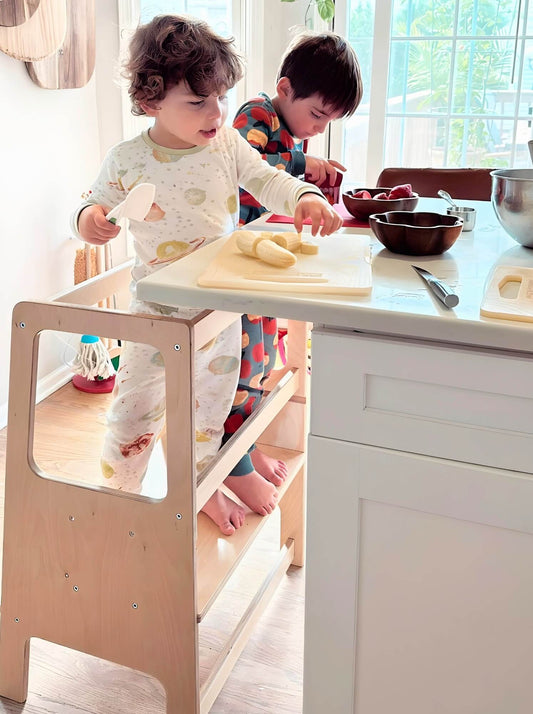
The Toddler Tower is designed so that your child can access counters, sinks, surfaces safely, with railings, stable construction, and appropriate height adjustments.
When a child uses that tower, they are able to reach, participate, and ask questions “What’s this?” “Can I stir?” “How do I pour?” All with your guidance. Over time this builds confidence: I can stand here, I can help, I can be part of the action.
Also, being invited to help fosters responsibility. Toddlers begin to understand that their actions matter: “I poured the water.” “I washed the spinach.” These small jobs build a sense of agency. They feel, and actually become, helpers.
Independence is also about choice. When your child is at your level, they can see what you’re doing, ask to join, pick small tasks. They aren’t relegated to the floor or a chair where they’re out of the loop. They’re part of the team.
Sharing these moments fosters social skills
Work in the kitchen is inherently social. You and your toddler share a space, a task, a goal. Here are some ways this fosters social skills:
-
Turn-taking and cooperation: You may let the toddler stir while you hold the bowl. Then you pour while they watch. These small shifts teach patience, waiting, and sharing.
-
Observation and imitation: Toddlers pay close attention. They watch your movements and mimic them. That’s how social learning happens.
-
Communication: You talk, explain, ask questions (“Do you think the carrot is clean?”). The child responds, gestures, asks questions back.
-
Celebration of success: When the dish is finished or the task done, you share the moment. “We did it together!” That reinforces connection, belonging, and positive social reinforcement.
-
Confidence in group settings: If your child often helps in the kitchen at home, they’ll be more comfortable in other group-scenes later: at preschool, playdates, family cooking events. They have already felt capable and included.
Practical toddler tower activity ideas for 18-36 months
Here are some specific activities you can try with your toddler using the tower:
-
Veggie washing: Let your child rinse vegetables under the tap. Use a bowl or colander. Talk about colours, shapes, textures.
-
Stirring: In a mixing bowl, give them a safe spoon and let them stir pancake batter, cookie mix, or scrambled eggs (above age-appropriate tasks). They love the motion and being the “assistant”.
-
Pouring: Use a small pitcher or measuring cup. Let them pour water (or milk) into measuring cups or bowls. Helps hand-eye coordination and control.
- Cutting soft fruits: With a toddler safe knife (or butter knife), let them “cut” bananas or cooked pasta (with supervision). This builds fine motor and decision-making.
-
Setting the table: After you cook, ask them to carry a plastic cup, a napkin, or spoon to the table. They feel part of the meal.
-
Washing up: After cooking, they can help rinse the bowl, hand you a dish towel, dry a small plate. It teaches clean-up just as much as cook-up.
-
Tasting and naming: Encourage them to taste ingredients and say “sweet”, “sour”, “crunchy”. This builds vocabulary and sensory awareness.
Tips for success and safety
- Ensure the tower is properly assembled and adjusted. RAD’s product offers adjustable platform height, safety rails and a stable design.
- Always supervise closely. Even though the toddler is at counter height, you must watch for balance, reach, and safe tool use.
- Choose age-appropriate tasks. At 18-24 months the tasks might be very simple (washing, stirring). At 30-36 months you can step it up a bit (pouring, setting the table, cutting soft food).
- Be patient. Sometimes your toddler may slow things down; that’s OK, it’s part of learning.
- Embrace the mess. These are learning moments, not just efficient cooking sessions. The juice may drip, the flour may puff, that’s fine.
- Celebrate effort, not just outcome. Saying “Thank you for helping” reinforces their role. Even if the dish is messy, the moment is valuable.
- Make it routine. Invite your child to join frequently but with purpose. The more you have them involved, the more natural it becomes.
-
Create a dedicated spot. If possible, keep their tower in a consistent place. That stability helps them understand, “This is my helper station.”
When you invite your toddler to stand on the tower and work alongside you, you are doing much more than cooking. You are building independence, confidence, social skills, and life-long habits. The home becomes theirs just as much as yours. By using our Toddler Tower, you’re giving them a safe, well-designed means to join you at the counter, turning everyday routines into meaningful shared moments.
Between 18 and 36 months your child is ready for this kind of inclusion. The kitchen becomes a classroom, a playground, a place of connection. You’re not handing them a toy, you’re handing them responsibility, trust, and belonging.
Encourage, support, and enjoy those little arms stirring, pouring, washing, setting alongside you. These are the building blocks of confidence, competence, and happy memories.





 Off
Off
