


From Toddler Towers to Texture: Cultivating Sensory-Rich Environments in a Family Kitchen
Share
In the educational philosophy of Maria Montessori, the home environment is never a passive backdrop for a child’s development. Instead, every room offers a unique set of purposeful opportunities to refine senses, build physical coordination, and encourage independent exploration.
The family kitchen is arguably the most vibrant and sensory-rich laboratory available to a young child within the home. By intentionally preparing this daily gathering space, parents can transform routine meal preparation into a deeply engaging educational journey.
A truly prepared kitchen environment beautifully balances peak structural functionality for adults with safe accessibility and sensory exploration for children. When we think of sensory design for toddlers, our minds often jump to small tactile toys or isolated sensory bins filled with dry rice.
However, a developing child’s entire surroundings contribute to their sensory landscape, from the floorboards beneath their tiny feet to the architectural fixtures overhead. Integrating a rich variety of diverse materials and authentic textures directly into the room’s permanent design encourages natural curiosity and cognitive growth.
The Foundation of Independence: Accessible Woodwork
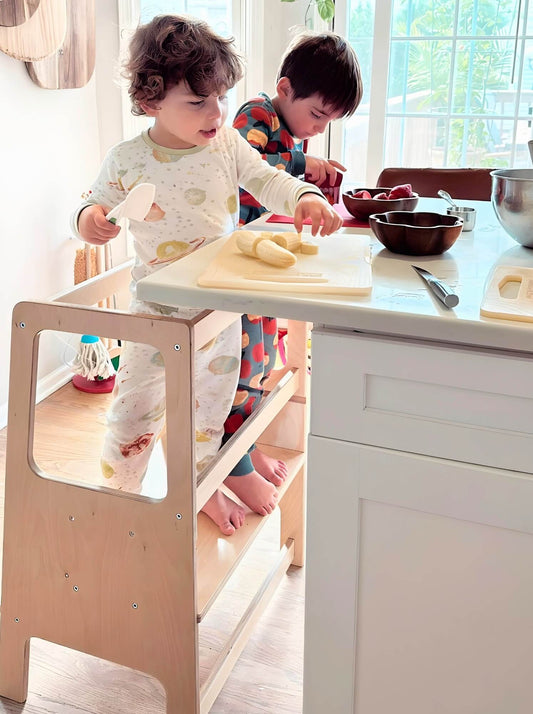
To begin engaging in any meaningful kitchen work, a young child must first be able to safely access the adult-sized environment. A high-quality learning tower provides a stable, secure elevation that allows a toddler to stand comfortably at standard counter height.
Crafted from smooth, natural hardwoods, these towers offer an inviting tactile experience that immediately connects growing children to the natural world. This crucial physical accessibility completely shifts their daily perspective, transforming them from passive observers on the floor into active participants in family rhythms.
Natural wood serves as an excellent anchor for a sensory-rich kitchen because of its organic warmth and distinct grain patterns. As children grip the sturdy rails of their learning tower, their hands absorb the grounding, authentic texture of real, crafted timber.
This stands in stark contrast to the sterile, completely uniform feel of synthetic plastics that dominate so many modern children's products. Surrounding children with authentic, beautifully finished materials teaches them from infancy to appreciate true quality, lasting craftsmanship, and organic variations.
The Contrast of Elements: Introducing Industrial Textures
A well-designed Montessori home environment thrives on thoughtful visual and physical contrast, which naturally stimulates a child’s observational skills. While the lower half of the kitchen space is dedicated to the warm, natural textures of wooden child-sized furniture, the upper elements can provide a stunning architectural counterpoint.
For instance, pairing the soft wood grains of a learning tower with the sleek, matte, or hammered finishes of a premium worldcoppersmith black range hood creates a visually captivating environment. This striking structural contrast invites children to look upward, broadening their spatial awareness and appreciation for diverse home design elements.
Exposing children to these contrasting textures, ranging from organic wood to metallic finishes, enriches their understanding of material science from an early age. They learn to visually and tactilely identify that some surfaces are warm and porous, while other architectural elements are cool, smooth, or distinctively patterned.
This sophisticated layout proves that a family-focused kitchen space does not require sacrificing elegant aesthetic choices for utilitarian safety. Instead, high-end design fixtures and child-friendly pieces work together to create a multi-layered sensory map that inspires everyone.
Practical Life Skills: Sensory Exploration in Food Prep
Once a child is securely elevated and situated within this beautifully balanced space, the real work of practical life can unfold. The kitchen operates as a living laboratory where every individual task inherently engages and refines the five primary human senses.
Washing crisp vegetables under cool running water teaches a toddler about fluid dynamics, water pressure, and temperature changes. Peeling a textured citrus fruit or snapping fresh green beans provides excellent auditory and tactile feedback that refines fine motor coordination.
Allowing children to handle authentic kitchen tools, such as small spreaders or wooden chopping blocks, further enhances their tactile discrimination skills. They learn to modulate their grip pressure and physical strength depending on whether they are slicing soft bananas or stirring heavy grain batter.
The varying weights, temperatures, and resistances of real food items build intricate neurological pathways that plastic toy food can never replicate. These meaningful, hands-on tasks foster deep mental concentration, emotional regulation, and a profound sense of personal accomplishment.
Acoustic Mindfulness: Cultivating a Calm Atmosphere
Sensory design is never limited strictly to what a child can touch or see, as the acoustic environment plays an equally vital role. A chaotic, excessively noisy kitchen space can quickly overwhelm a young child’s developing nervous system, leading to sudden frustration or sensory fatigue.
Choosing high-quality, quiet appliances ensures that the central kitchen remains a peaceful sanctuary that is entirely conducive to learning. When harsh background noise is minimized, young children can better focus on the subtle, satisfying sounds of their own delicate tasks.
A calm acoustic backdrop also directly invites meaningful verbal communication between parent and child during busy daily meal times. It allows for quiet, mindful conversations where parents can narrate their actions and introduce rich descriptive vocabulary words completely naturally.
When a kitchen feels serene, toddlers are far more likely to sustain their attention on mastering intricate practical life skills. This careful management of sound transforms the kitchen from a stressful, high-traffic zone into a peaceful center for deep family connection.
The Lifelong Benefits of a Prepared Kitchen
Cultivating a sensory-rich, Montessori-inspired kitchen is an intentional investment in a child’s cognitive, emotional, and physical development. By blending accessible children's furniture with sophisticated, textured architectural design, parents create an enriched space that perfectly respects both style and child-led learning.
This holistic environment encourages toddlers to explore their world confidently, developing an early appreciation for beauty, structural order, and functional design. Ultimately, these early kitchen experiences lay a resilient groundwork for lifelong independence, mindfulness, and healthy family habits.





 Off
Off
