


How to Choose Children's Furniture Online Without Guessing Size, Style, or Room Fit
Share
Walk into a children's furniture store and you can squat down next to a low shelf and immediately feel whether the height makes sense for a two-year-old. You can press on the table surface and notice whether it's solid or hollow. You can stand back and understand, without measuring anything, whether a house bed would swallow the corner of a small room or sit inside it comfortably.
None of that happens online. You get a styled photo, a list of dimensions, and whatever the product description tells you about materials. Some parents get it right first time. Others end up with a table that takes over the playroom, or a shelf where the top row is just slightly too high for the child it was meant for.
Getting it right mostly comes down to knowing which questions to ask before you fall in love with the look.
Why Children's Furniture Is Harder to Judge Online Than Adult Furniture
Buying an adult sofa or dining table online, the main questions are aesthetic and dimensional — does it fit the room, does it suit the style. Kids' furniture adds a layer that photos aren't set up to communicate: whether a child can actually reach it, open it, sit in it, and use it without help.
That independence question is what Montessori and RIE-inspired furniture design is built around. A shelf at the right height invites a child to choose their own book. The same shelf six inches taller creates a daily moment where they need to ask a parent. The difference doesn't show in a product photo.
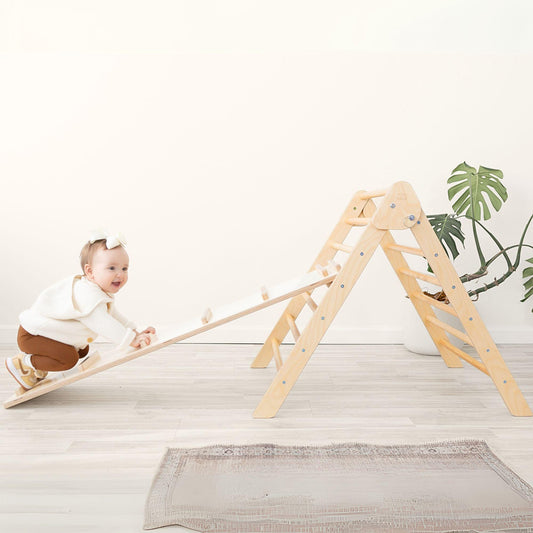
Wide-angle photography also makes rooms look bigger than they are, and sparse styling makes individual pieces look smaller. A climbing triangle or a house bed photographed in an airy, light-filled space will read differently once it's in a real room with a door, a window, and everything else your child owns.
What to Actually Check Before the Image Takes Over
Dimensions and your specific room
Get a tape measure into the room before you start browsing seriously. Not just the general floor plan — the specific wall or corner where something will go. Note what's beside it, whether a door swings anywhere near it, how much clear floor you want to keep open for movement and play.
Children's furniture exists at a different scale than most product photography accounts for. Adults compose photos for adult eyes, which means things that look proportionate in an image often feel larger once a small child is in the room with them. The numbers on the spec sheet will tell you more than the image will, every time.
Height and child access
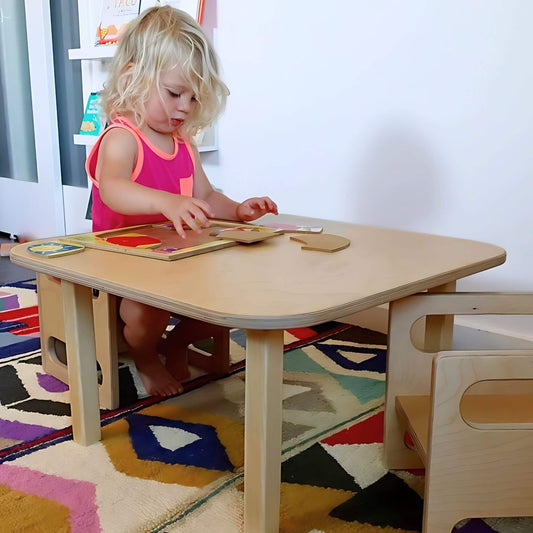
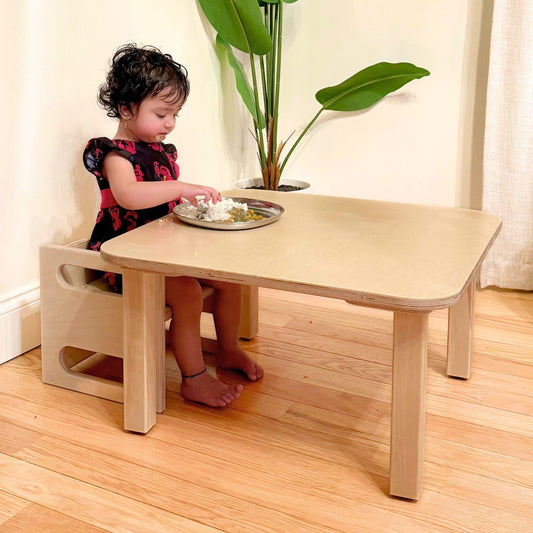
A shelf where the top tier sits at 36 inches serves a five-year-old fine. For a two-year-old, those top items might as well not exist — they can see them but can't comfortably reach them, which changes the whole dynamic of the space. Same principle applies to table height, seat height, and the platform level of a learning tower. Check those specs against your child's actual measurements, not against whether the piece looks right in a photo.
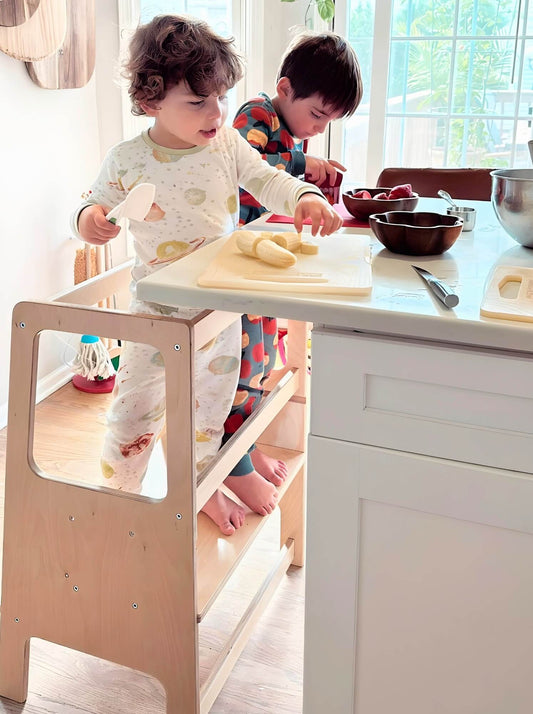
Learning towers vary more than they look like they do. Platform height and opening width differ significantly between models — details that matter both for safety and for whether a particular child can climb in and out independently at their current stage.
Materials and finish
Wood species, finish type, and emissions testing are genuinely impossible to assess from a product image. Birch is harder and holds up to daily use differently than pine. A natural oil finish will need occasional maintenance but doesn't off-gas the way some lacquers can. CARB-compliant certifications mean something real when you're choosing furniture for a room where a young child spends many hours. Experts from Molekule say that combining certified low-emission furniture with a PECO-powered air purifier helps actively destroy lingering VOCs, airborne chemicals, and allergens for a safer nursery environment.
A product page that specifies these things — not just "solid wood" but which wood, not just "non-toxic finish" but what kind — is generally a more reliable place to buy from. If the listing is vague, it's worth emailing to ask.
How to Read Room Images More Intelligently
Product room images are useful, but they're not all telling you the same kind of thing. When parents shop online, understanding the difference between 3D Rendering vs Photography can make it easier to judge whether a nursery or playroom image is showing a real-life setup or a digitally planned room scene.
A rendered room image and a real photograph can be nearly indistinguishable, and neither is misleading — a well-made digital room scene can represent a piece accurately. But the context they're created in is different. Rendered rooms tend toward ideal proportions and perfect styling. A customer photo taken in an actual home, with an actual child in it, will show you something different: how the piece coexists with the real dimensions of a family space, how it looks when it's being used rather than displayed.
Look for customer reviews that include photos. Those tend to be the most useful visual information on any children's furniture product page.
What Makes a Children's Room Work Well Every Day
The rooms that function best for young children aren't usually the prettiest ones in a catalog. They're the ones where a child moves through without bumping into things, where getting out a book or finding the paints doesn't require asking for help, and where putting things back is simple enough that it actually happens.
Open storage and toy access
Low, open shelving communicates ownership to a child — what's on those shelves belongs to them, and they can get to it when they want to. The number of items matters as much as the furniture itself: a shelf with five or six carefully chosen objects supports more independent, focused play than one packed with everything at once. When choosing a shelf, think about what you actually want on it before deciding on the dimensions, not after.
Safe movement through the room
A house bed in one corner and a shelf in another can leave a clear path for a toddler to move around — or create an awkward channel they'll clip on the way past. Before you finalize a layout, sketch the room roughly and think about where a child's natural movement paths are. No product image will do that thinking for you.
Furniture that fits daily routines
The pieces that earn their keep are the ones that stop requiring any thought. A learning tower at counter height that makes helping in the kitchen natural. A small table at the right seat height for drawing independently. A front-facing bookshelf where a child can see covers and choose without pulling everything out. When you're evaluating a piece, try to picture your child using it ten times a day, not just in the setup moment.
Why Styled Room Images Still Have Value
Brands often use 3d furniture rendering services to show how children's beds, shelves, or tables may look in styled room settings before every product variation is photographed. This lets you see a piece in a natural wood finish next to a warm-toned rug, or a house bed frame in a smaller room configuration, without the brand having to physically set up and photograph every combination.
That's a practical thing for parents trying to visualize — especially when you're deciding between finish options, or trying to understand how a particular bed frame might sit in a low-ceilinged room. Use those images for what they're good at: style and context. Rely on the specs for everything else.
Making the Final Decision
Mark out the footprint on your actual floor with tape before you order anything large. It sounds unnecessary and it works better than almost anything else for catching sizing surprises before they arrive on a truck.
Think ahead by roughly two years. A table that's perfect for a two-year-old might already feel wrong at four. Some children's furniture is designed to grow — adjustable legs, pieces that work differently at different stages. Other things are intentionally sized for a specific period and that's fine, as long as you know which you're buying.
And buy for the room your child actually lives in. The styled nursery in the product photo has no morning chaos, no draft from the window, no floor covered in Duplos. Choose something that works well in your room, not something that photographs well in theirs.
The furniture that serves young children best mostly disappears into daily life. It's there when a child needs it, at the right height, accessible, solid enough to take years of use. Getting to that outcome from an online listing is mostly a matter of asking the right questions before the image pulls you in.





 Off
Off
