


The 8 Best Furniture Investments for Homes With Young Children
Share
Furniture works harder in a home with young children. A coffee table becomes a racetrack, a sofa hosts snack time, and a bookcase can look like a climbing frame. The right pieces should make family life easier without turning every room into a nursery.
The best investments share four qualities: stability, cleanability, sensible proportions, and the ability to remain useful as children grow. Here are eight purchases worth considering.
1. A Modular Sofa With Washable Covers
The sofa may host reading, playdates, naps, movie nights, and the occasional pillow fort. Choose a model with a sturdy frame, removable upholstery, and sections that can be rearranged or replaced independently.
Check whether the seat, back, and base covers can all be removed, and read the care instructions before buying. Tightly woven fabric is usually easier to vacuum than deep textures that trap crumbs.
A practical place to compare these features is soulfa.com. Soulfa builds its sofas from individual modules and offers interchangeable, machine-washable covers on its fabric seating. Families can change a layout or refresh the upholstery without automatically replacing the entire sofa.
Individual cubes can also be purchased separately, which may help a sofa adapt after a move. Still, measure carefully. Very deep seating can overwhelm a small room, and loose cushions that need constant reshaping may frustrate busy families.
2. A Crib That Converts Safely
A convertible crib can become a toddler bed or daybed, but conversion features should never take priority over current safety requirements.
The U.S. Consumer Product Safety Commission’s “Full-Size Baby Cribs” FAQ explains that the federal regulation is codified at 16 C.F.R. part 1219. The requirements address hazards such as falls, entrapment, hardware failure, and problems caused by poor assembly or maintenance.
The mattress must also fit the crib correctly. CPSC guidance states that a mattress used in a full-size crib must measure at least 27¼ inches by 51¼ inches and mustn’t exceed 6 inches in thickness. These dimensions are intended to reduce gaps that could create entrapment or suffocation hazards.
Safe use matters just as much as the furniture itself. In “Safe Sleep: Back Is Best, Avoid Soft Bedding, Inclined Surfaces & Bed Sharing,” published on June 21, 2022, the American Academy of Pediatrics recommends placing infants on their backs on a firm, flat, noninclined sleep surface. Soft toys, pillows, blankets, and other loose bedding should stay outside the crib.
Before buying a convertible model, confirm that the required conversion kit is included or still available from the manufacturer. Product lines change, and the crib can’t offer long-term value if the necessary parts are no longer sold.
3. A Stable Dresser With an Anti-Tip Restraint
Open dresser drawers shift weight towards the front, while handles may tempt young children to climb. Choose a stable unit that includes an anti-tip restraint and follow the manufacturer’s installation instructions.
The CPSC’s Anchor It! safety campaign advises families to secure top-heavy furniture, install the anti-tip devices supplied with new dressers, and keep toys, remote controls, and other appealing objects away from the top. These steps reduce the temptation to climb and help prevent furniture from tipping forward.
An anti-tip kit shouldn’t remain in the packaging. Attach it to a suitable wall structure using the correct hardware for the wall type. Families who rent should discuss safe installation with the property owner rather than leaving a potentially unstable dresser unsecured.
Place heavier belongings in the lowest drawers where practical. Children should also be discouraged from opening several drawers at once, although supervision isn’t a substitute for properly securing the furniture.
4. Low, Open Shelving
Low, open shelving allows children to independently see, choose, and return books or toys without relying on an adult. This simple design encourages responsibility, confidence, and decision-making while also making a room easier to organize because each item has a clear, visible place. As we discuss in our article on designing a home that supports independence, thoughtfully arranged environments help children participate more fully in everyday life.
Look for smooth edges, a stable base, and enough depth to hold books and containers securely. Store heavier objects on the lowest shelves and follow the manufacturer’s anchoring instructions. The CPSC recommends securing top-heavy furniture and removing objects that may encourage children to climb.
Avoid filling every available space. A small rotation of books, puzzles, and open-ended toys gives children manageable choices and makes cleanup less daunting. Later, the same unit can hold art materials, games, or school supplies.
5. A Child-Sized Table and Chairs
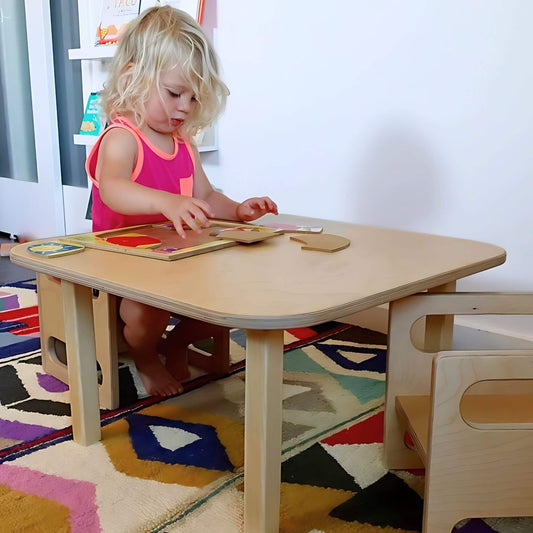
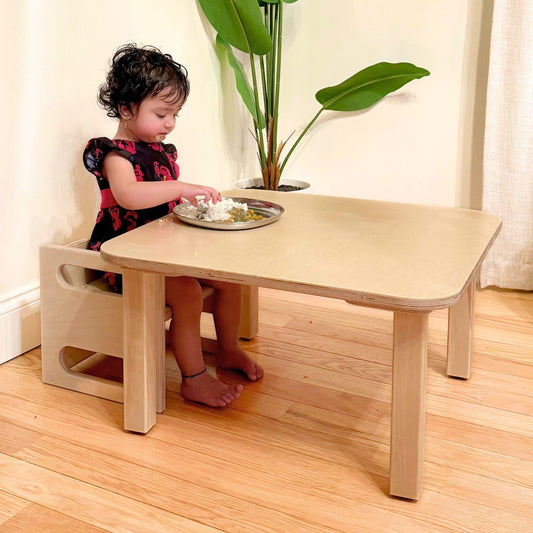
A properly proportioned table gives children a dependable place to draw, build, eat snacks, complete puzzles, and work independently. When furniture fits their bodies, children can climb into their chairs without help, sit comfortably, and focus on the activity in front of them instead of struggling to reach or balance. They can sit without climbing onto an adult chair, while a comfortable position helps them focus on the activity in front of them.
Choose rounded corners, a wipeable finish, and legs that sit firmly on the floor. Chairs should remain stable when a child turns or reaches. Adjustable legs can extend the set’s lifespan.
Place the table where adults can supervise easily, such as near the kitchen or in a shared family room. A child-sized work area also keeps paint, blocks, and craft projects off the main dining table.
6. Toy Storage Without a Dangerous Lid
Large toy chests hide clutter quickly, but heavy hinged lids can create head, neck, entrapment, and suffocation hazards.
The CPSC recommends open bins, lidless chests, lightweight removable lids, or designs with sliding panels. A vertically opening lid should have a support that holds it open in every position.
Ventilation matters in storage large enough for a child to enter. Avoid automatic latches, and check the recall database before buying a used chest.
Shallow, labeled bins often work better in daily life. Children can see what belongs inside, reach toys without leaning deep into a box, and take part in cleanup.
7. An Expandable Dining Table
A dining table often doubles as a craft surface, homework desk, game table, and gathering place. An expandable model can serve all these purposes without taking up extra space every day.
Choose a finish that tolerates frequent wiping and ordinary wear. Rounded or softly shaped corners help in tight walkways. Check the extension mechanism for pinch points, and store removable leaves where children can’t pull them down.
The adaptability seen in Soulfa’s modular seating offers a useful comparison: large furniture purchases work harder when they can change with the household. An extendable table provides extra room for guests and projects while retaining a smaller everyday footprint.
8. An Adjustable Desk and Supportive Chair
A preschooler may not need a formal study area, but an adjustable desk can begin as an art station and later become a homework space.
Prioritize a clear work surface and a chair that supports a stable sitting position. Height adjustment is more useful than built-in gadgets that may date quickly.
Once devices enter the room, add cable management and keep cords away from younger siblings. Drawers should open smoothly without creating finger-trapping points.
A simple design also moves more easily between rooms and age groups. Neutral furniture can shift from a playroom to a bedroom without looking childish.
Conclusion
The best family furniture doesn't just stand up to spills, bumps, and everyday wear. It helps children participate more independently in daily life while making routines easier for parents. Whether it's a low shelf that encourages a child to choose their own books, a child-sized table that supports creative play, or a durable sofa that can adapt to a growing family, the most valuable pieces continue serving your household for years.
Before making a purchase, ask whether the furniture is stable, easy to clean, appropriately sized, and built to adapt over time. Look for pieces that can be repaired, expanded, converted, or repurposed as your family's needs change.
Good family furniture doesn't need to be indestructible or overly childlike. It should create a home where children can safely explore, learn, and become more independent while making everyday life more enjoyable for everyone.





 Off
Off
