


Toddler Tower Vs Stool: What’s Safer For Kitchen Help?
Share
Kids love "helping" in the kitchen, stirring batter, washing veggies, sneaking a blueberry or two. The question caregivers keep asking is simple: Toddler Tower vs stool, what's safer for kitchen help? The answer depends on stability, guard rails, and how the child uses the platform day to day. This guide breaks down the key safety differences, explains how to choose based on a child's readiness and available space, and offers practical tips that actually hold up in a busy kitchen. Never leave a child unattended. Only use at a counter.
What Is A Toddler Tower Vs. A Stool?
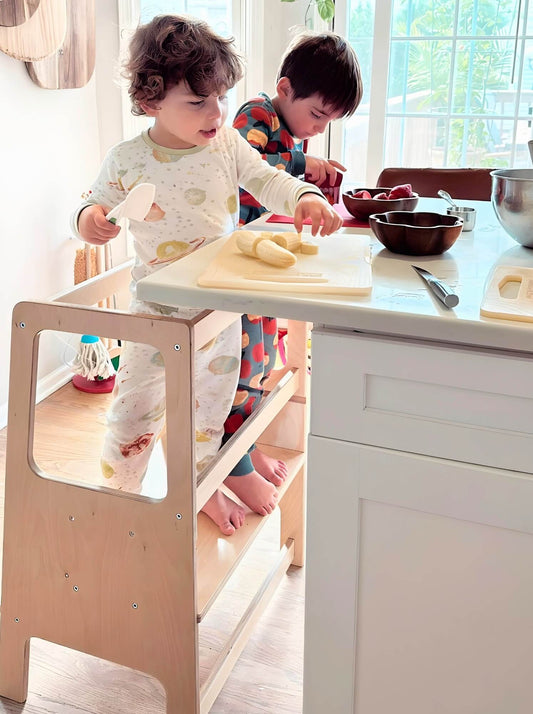
A toddler tower (often called a learning tower or kitchen helper) is a purpose-built platform that raises a child to counter height within a partially enclosed frame. Most include guard rails on multiple sides, a wide base for stability, and adjustable platform heights. The idea is to let a child participate at the counter while providing protection against lateral falls.
A stool, chair, or kitchen stool is a simple platform that provides a place to sit at a height. Some have a single step; others offer two or three steps. While many stools are sturdy and compact, they typically lack surrounding rails or an enclosure and don't always match a child's center of gravity as they lean, reach, or pivot.
Put simply, both lift a child to counter height, but a toddler tower is engineered for standing and assisting at a counter with added containment and stability. A stool is a general step aid and relies more on the child's balance and adult supervision.
Safety Differences That Matter
Stability And Tip-Over Resistance
Toddler towers generally use a wider footprint and a more even weight distribution to reduce tipping when a child leans or shifts weight. Many include anti-tip geometry (wider at the base) and thicker materials. In contrast, lightweight stools, especially narrow ones, are more likely to rock or skid if the child climbs fast, leans to the side, or reaches across the counter.
What to look for:
- A tower with a broad base and solid joinery (no wobble).
- For stools, choose models with a low center of gravity and a non-skid base: avoid tall, narrow stools.
Guard Rails And Enclosure
The defining difference: towers surround the child with guardrails that can prevent a lateral fall if the child pivots or loses balance. Some towers have three-sided enclosures with the counter acting as the fourth side; others have four sides with an entry gate.
Stools, even those with a small handle, offer far less containment. For children who still test boundaries, guardrails drastically reduce "oops" moments while reaching, mixing, or washing.
Slip Resistance And Footing
Towers often feature a platform that is deep enough to allow a natural stance. Many stools use smooth wood or plastic: when wet or soapy, surfaces can be slick. The smaller the step, the easier it is to misplace a foot.
Climbing, Mounting, And Egress
Towers usually provide a defined entry point with handholds so kids learn a consistent "mount and dismount" routine. Predictable movement reduces missteps. Stools require more balance and often tempt side-mounting or hopping off, common points for slips.
Very important: if a child starts using any product as a climbing toy, climbing up the sides, scaling guard rails, or standing on top of safety rails, they should be redirected immediately and only allowed to use it for proper, intended use. Consistent redirection helps set safe habits.
Height Adjustability And Fit To Counter
A good fit to counter height is a big deal. Towers typically offer adjustable platforms that align the child's elbows just above counter level. That posture reduces overreaching and awkward leaning. Many stools are fixed-height: if they're too low, kids lean forward, shifting weight and increasing fall risk; too high, and they can bump torsos or chins on the counter.
Bottom line: for dedicated kitchen help, a toddler tower's stability, enclosure, traction, and adjustability collectively create a safer environment than a typical stool. Supervision still isn't optional. Never leave a child unattended. Only use at a counter.
Age, Readiness, And Supervision
Signs Your Child Is Ready
Chronological age helps, but readiness matters more. Indicators a child may be ready to use a toddler tower include:
- They can stand steadily without frequent falls and step up with support.
- They follow simple one-step directions ("hold the rail," "turn around to step down").
- They show interest in helping and can focus for a few minutes.
- They understand basic boundaries (wait hands, hot/cold cues).
If any of these are shaky, start with very short sessions while holding the tower and coaching hand placement. For stools, raise the bar: only children with reliable balance, strong listening skills, and experience can use one safely at the counter.
Rules For Safe Use
Clear, consistent rules reduce risk and keep kitchen time fun:
- Never leave a child unattended. Only use at a counter.
- Feet stay on the platform: hands on rails (for towers) or on the counter edge (for stools) when reaching.
- No leaning over the side, no pushing the unit, no hopping off.
- If the child climbs the outside, scales the rails, or stands on top of the sides/safety rails, stop and redirect to proper use, or end the session.
- Turn toward the steps to get down: no jumping.
- Keep sessions short at first: fatigue leads to wobbly decisions.
When To Choose A Toddler Tower Vs. A Stool
Scenarios Favoring A Toddler Tower
- Younger helpers or those still mastering balance and boundaries.
- Families who plan frequent, lengthy kitchen sessions.
- Counters where reaching requires leaning, rails add a protective buffer.
- Homes with multiple kids sharing one station: an enclosure reduces bumps and jostling.
- Caregivers who want an adjustable height to fit growth and various counters.
In these cases, a toddler tower typically offers safer, more predictable support.
Scenarios Where A Stool Can Work
- Older children with strong balance and consistent rule-following.
- Very tight spaces where a tower simply won't fit, and only for brief, fully supervised tasks at the counter.
- Temporary or travel setups where a sturdy, wide-base, non-slip stool is the only option.
When using a stool: choose a low, broad design with rubber feet, add a non-slip top, park it flush against the counter, and supervise within arm's reach at all times. The moment a child starts to climb the sides or get playful, end the session and reset expectations.
For kitchen help, the Toddler Tower vs. stool comparison isn't close on safety: a well-designed toddler tower generally wins thanks to stability, guardrails, and adjustable height. That said, a sturdy, non-slip stool can work for older, steady kids under vigilant supervision and only at a counter. The constant: Never leave a child unattended. If a child treats either option like a climbing toy, scaling sides, or standing on rails, redirect immediately and reserve it for proper use. With the right setup, clear rules, and calm routines, shared kitchen time becomes safer, happier, and genuinely helpful.
If you're deciding how to integrate a tower into your space, you may also find these guides helpful: How to Set the Right Tower Height for Your Counter and Best Toddler Tower Activities.
Frequently Asked Questions:
What’s the difference between a toddler tower and a stool for kitchen help?
Both lift kids to counter height, but a toddler tower surrounds the child with guard rails, uses a wider base for stability, and often has an adjustable platform. A stool is a general step aid that relies more on a child’s balance and close adult supervision.
Which is safer: the Toddler Tower or the stool for kitchen activities?
For most families, a well-designed toddler tower is safer due to its stability, guardrails, and adjustable height, which reduces overreaching. A sturdy, non-slip stool can work for older, steady kids—but only at a counter, with vigilant, within-arm reach supervision at all times.
How do I know my child is ready to use a toddler tower?
Readiness matters more than age. Look for steady standing, ability to step up with support, following simple one-step directions, showing interest in helping, and respecting boundaries, such as hot/cold cues. If skills are developing, start with brief, coached sessions to reinforce hand placement and a consistent mount-and-dismount routine.
What safety features should I look for in a tower or stool?
Choose a broad base with solid joinery, multi-sided guard rails (for towers), and a large standing platform. Favor adjustable height for proper elbow level, and place the unit flush to the counter. Keep surfaces dry, check hardware monthly, and enforce clear, consistent rules.
When should I transition from a toddler tower to a stool?
Consider a switch when your child demonstrates strong balance, consistent rule-following, and can stay focused on short tasks without leaning or twisting. In very tight spaces or for brief, fully supervised jobs, a low, wide, non-slip stool can work. If play or climbing starts, pause and reset expectations.
Are DIY toddler towers safer than store-bought options?
DIY can be safe if you prioritize structure and finish quality: use a wide footprint, sturdy materials, reliable hardware, smooth edges, multi-sided guard rails, and a large platform. Follow vetted plans, test for wobble, and inspect fasteners regularly.





 Off
Off
